
Guest column
Surrey has some of the UK’s highest incomes. So why are women still less likely to invest?
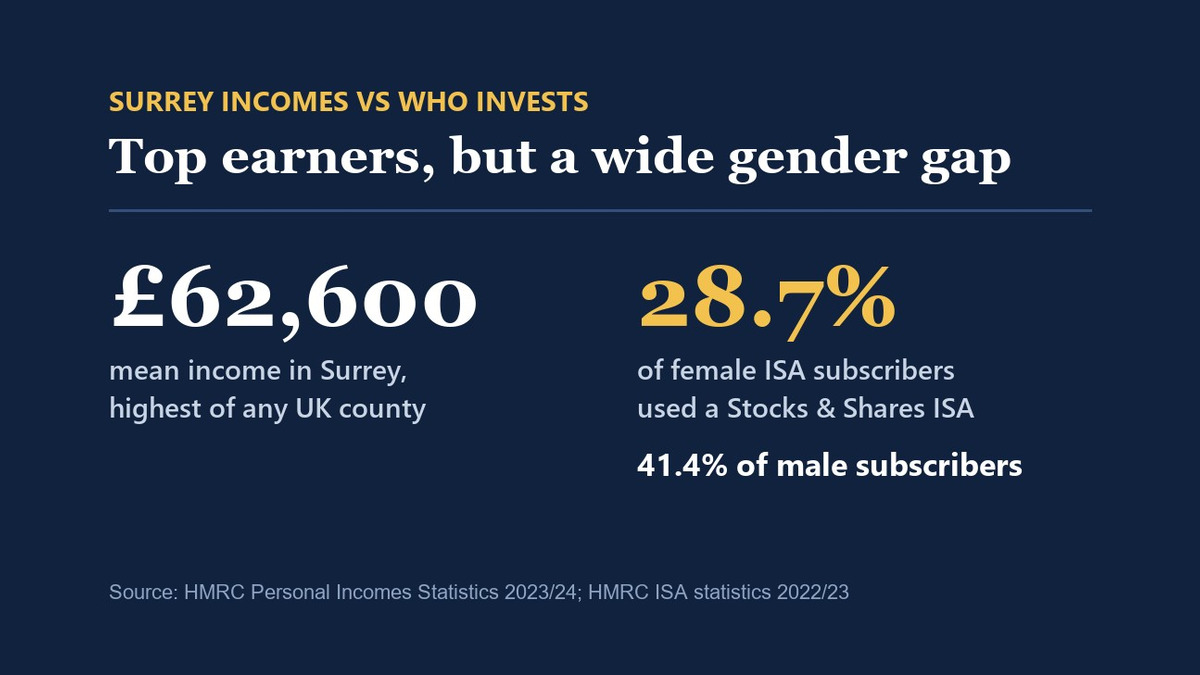
According to HMRC’s Personal Incomes Statistics for 2023/24, Surrey has the highest mean and median personal income of any UK county, at £62,600 and £37,100 respectively. That puts many people in Surrey in a relatively strong position to save, invest and build long-term wealth.
HMRC’s latest detailed figures show there were around 21.3 million adult ISA holders across the UK in 2022/23, and 43.4% of adults in the South East held an ISA, compared with 39.4% across England.
But there is an interesting difference in how men and women use those ISAs. According to the latest detailed HMRC ISA data available by sex, women actually slightly outnumber men among ISA holders overall, accounting for 51.6% of holders. Yet among people who subscribed to an ISA that year, around 28.7% of female subscribers put money into a Stocks & Shares ISA, compared with 41.4% of male subscribers.
So the issue is not simply whether women save. Many clearly do. The more interesting question is what happens to that money once it has been saved, particularly when it is intended for the long term.
There are many reasons women may feel more comfortable holding cash. Investing can seem complicated, there is the fear of seeing an account balance fall when markets move, and some people still associate investing with choosing individual companies or constantly watching share prices. Cash feels predictable.
However, predictability does not mean there is no risk. Cash has an important role for emergencies, short-term spending and money you may need to access soon. Over longer periods, however, inflation can gradually reduce what that money can buy if the interest earned does not keep pace with rising prices.
That does not mean all savings should be invested. It means different money has different jobs. Some needs to remain safe and accessible; other money may have a long enough timeframe to be considered for longer-term growth.
Your 40s and 50s can be a wake-up call
For many of the women I speak to, this becomes much more important in their 40s and 50s. Retirement suddenly stops being something that will happen “one day” and starts to feel much more real.
You look properly at your pension, perhaps for the first time in years. You add up your savings. You may discover old workplace pensions you had almost forgotten about. Then the question becomes much more immediate: will this actually be enough?
In your 20s and 30s, it can feel like there is plenty of time to work it out later. In your 40s and 50s, you may still have another 10, 15 or 20 working years left, which is enough time to make a real difference, but suddenly every one of those years feels more valuable.
It is also worth remembering that many people are already investing without necessarily thinking of themselves as investors. Most workplace pensions invest contributions in funds, often spread across a wide range of companies and markets. A Stocks & Shares ISA can also hold diversified investments and has different tax and access rules from a pension. Investing therefore does not have to mean trying to pick the next winning company. The bigger issue is understanding how your pension, ISAs, savings and everyday finances fit together.
Start with the bigger picture
Before deciding whether money should stay in cash, go into a pension or be invested through a Stocks & Shares ISA, it helps to know two things: where you are now and where you want to get to. It is the same principle as planning any journey. You cannot work out the best route without knowing your starting point and your destination.
That means understanding what is actually coming in and going out each month, whether you have expensive debt, whether you have an emergency fund and what you already hold across pensions, savings and ISAs. Then there is the destination. When would you ideally like to retire? What would you like that retirement to look like? How much might you need to support it?
Many people know roughly what they earn and roughly what they have saved, but have never brought everything together into one clear picture. Sometimes doing that yourself with a spreadsheet is enough. Sometimes an outside perspective can help you see gaps or opportunities that are much harder to spot when each pension, ISA and savings account is viewed separately.
Surrey may have some of the highest incomes in the country, but a high income on its own does not automatically create long-term wealth. The real question is whether the money you are earning today is helping to build the life you want later.
Fahmida Rahman is a wealth and investment coach based in Camberley, Surrey, and the founder of Wealth with Fahmida. After more than 25 years working in investment banking, she now helps women understand pensions, ISAs and long-term investing. Find her at wealthwithfahmida.com or on Instagram.